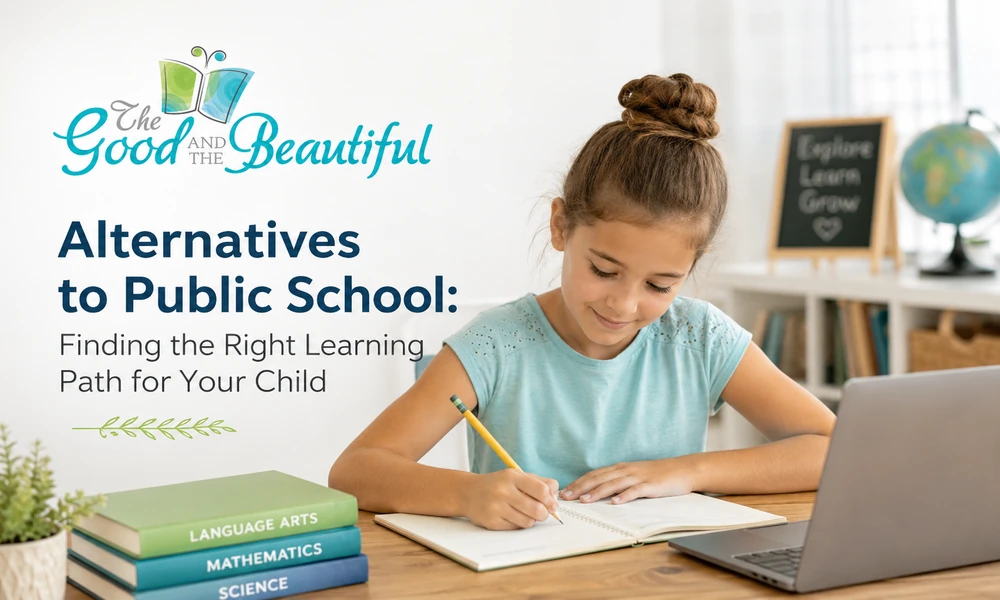
Every child learns differently. Public schools are home for many families, but not all. Many parents desire smaller classrooms, adapted schedules, focused teaching, or more control over what their kids learn. At least some families would benefit from exploring alternatives to public school modeled after their needs.
Begin with the Learning Experience You Want
Take the time before you select a school/program to consider what education looks like for your child.
Does your child need extra individualized attention? Is flexibility important? A structured class room or learn at home?
Going through a few questions can help to rule out options.
1. Private Schools
Private school is probably the most well-known alternative type of education to public school. Usually these are independently run and charge a fee.
Private schools often have smaller class sizes, specialized programs, or certain teaching styles. While some center around scholastics, others may focus more on arts, sports or innovation, and a particular teaching idea.
Try to compare tuition, curriculum, class size, transportation, and admission criteria before making a choice.
2. Homeschooling
According to the national center for home education, with homeschooling, parents have more control over the learning environment.
The families may select the teaching material, set schedules at their convenience, and keep adjusting the lessons according to the child’s pace. For students who need more time with one subject, it can be extended while the other subject can move on at a faster pace.
On the other end of spectrum, homeschooling is close to being a full-time job requiring pre-planning and continuous parental involvement. It is also important for families to know the homeschooling laws of their state.
3. Charter Schools
Charter schools are public schools in that they receive taxpayer funding, but in large part government regulators grant the charter schools freedom from many of the regulations to which traditional public schools must adhere.
They may have a specific academic focus or differentiating teaching style. Since programs differ, parents should look into each school individually rather than assuming all charter schools provide the same experience.
And then, of course, admissions can also go according to local regulations and available places.
4. Online Schools
Online education is where students finish their school lessons via the internet. Depending on the program, students could be instructed at home by live teachers, recorded lessons, or a combination of both.
This option can be ideal for families who require flexibility due to travel, schedules, and other reasons.
Online learning is still modeled more like correspondence courses, where students have to find ways to keep themselves organized and motivated to learn without the underlying structure of a physical classroom.
5. Montessori and Other Specialized Programs
Some families pick educational methods according to a certain teaching philosophy. Montessori schools emphasize a hands-on approach and more autonomy, for example.
Others center more around project-based learning, outdoor education, or arts, certain academic subjects.
When a child has a learning style that is not matched in a traditional classroom, these are options worth exploring.
No One Right Answer
There isn’t a right answer, the best education is specific to the child and family. For some it may be a private school, for others home school or online learning.
Finding alternatives to public school options provides parents with more options, while allowing them to focus on the type of learning environment that gives their child the opportunity to feel reinforced, engaged, and prepared for growth.

Comments are closed.