
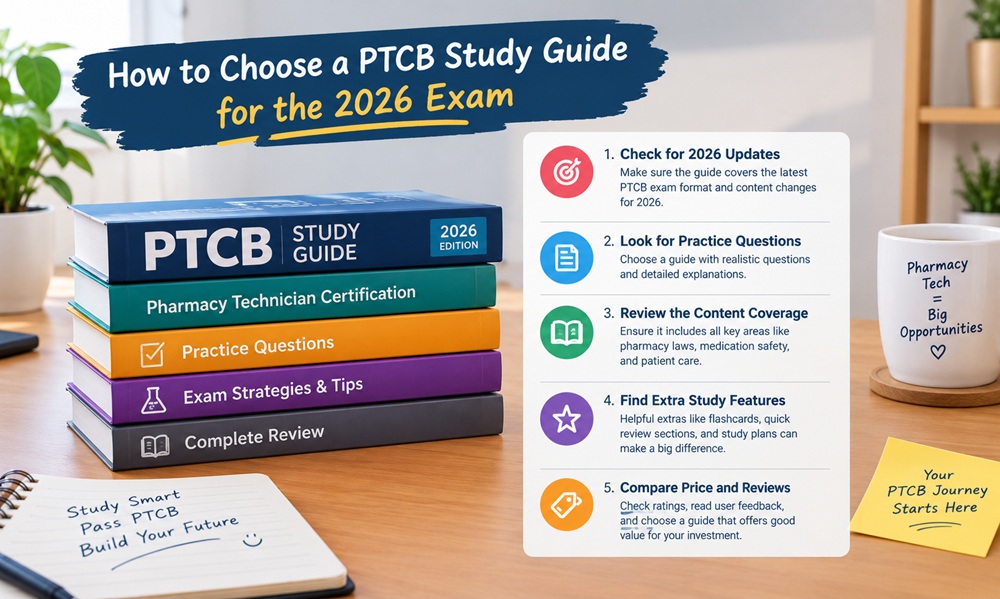
Choosing a PTCB study guide should begin with the exam content outline, not the year printed on a cover. A recently published book can still organize its material around an older blueprint, and a thick question bank can offer surprisingly little help if its explanations do not show how an answer was reached.
For candidates preparing for the Pharmacy Technician Certification Exam, or PTCE, the most useful purchase is a resource that matches the current content, explains difficult ideas clearly, and supports a study routine you can maintain.
Before buying another book, compare what you already own with the checks below. You may need a better explanation source, updated coverage, or more practice rather than an entirely new collection of materials.
Check the 2026 outline before comparing covers
PTCB’s current PTCE content outline took effect on January 6, 2026. It allocates the examination across four areas: medications at 35%, federal requirements at 18.75%, patient safety and quality assurance at 23.75%, and order entry and processing at 22.50%.
Use those areas as the starting point for evaluating a table of contents. A book devoted almost entirely to medication memorization needs supplementation, however helpful those chapters may be.
PTCB’s explanation of the content update identifies changes including the removal of specified nonsterile compounding content and alligation calculations, and the addition of Drug Supply Chain Security Act content. An older resource may still contain useful foundations, but you should identify where it differs from the examination you intend to take.
Ask the publisher which outline the book follows. Look for an edition history, update page, or sample chapter that makes the answer verifiable. A cover date by itself does not resolve the question.
Inspect the explanations before the question count
Open a sample chapter and find a practice item with a worked answer. Can you follow the reasoning without already knowing the result?
A useful explanation identifies the concept, shows the relevant steps, and addresses why a tempting alternative fails. An answer key that simply repeats the chosen option leaves you with more work to do when you misunderstand something.
For a calculation example, look for units and intermediate steps. You should be able to trace what is being calculated and why the numbers are arranged that way. If you cannot, it may be difficult to diagnose your own errors later.
For a scenario, inspect whether the explanation pays attention to the stated facts. Generic advice that could be attached to almost any question is less useful than an explanation of the specific distinction the item tests.
You can compare the structure of a prospective book with the PTCB study guide from Every Exam Prep, a free supplementary resource. Keep PTCB’s outline as the authority for exam coverage rather than treating any independent guide as an official curriculum.
Use a buying checklist that exposes trade-offs
Instead of asking which book has the most pages, compare the features you will actually use:
| What to check | Evidence to look for |
|---|---|
| Current coverage | A stated match to the January 2026 outline and a clear update policy |
| Explanation quality | Sample answers that explain reasoning and calculations |
| Topic organization | A table of contents that lets you find weak areas quickly |
| Practice access | Clear terms for online questions, codes, and expiration dates |
| Correction process | An errata page or a way to report suspected errors |
| Usability | Readable pages, workable digital navigation, and space for notes |
The checklist does not require one book to do everything. A concise reference can work well beside a separate question source. What matters is knowing which role each resource will serve before paying for it.
If buying used, ask whether any online access code has already been redeemed. Compare the price of the book alone with the features you will actually receive. A cheaper copy may still be a good choice when you do not need its online component.
Separate drug recall from the rest of preparation
Medication flashcards can make recall practice convenient, but they should be one part of the plan. Organize your study time so you also revisit the other areas in the current outline.
For each medication-related topic, decide what you are trying to retrieve. A card testing a name is different from an exercise asking you to interpret a scenario. Label your notes accordingly so you can see whether you are practicing recognition, explanation, or application.
Avoid judging coverage by how many cards you have collected. Return to the outline and check which areas your materials leave thin. If you cannot identify a chapter or exercise for an area, note the gap and find an appropriate source before buying another general-purpose deck.
For questions about real medication use or workplace procedures, follow your training and supervising pharmacist’s guidance. Exam preparation is not a substitute for professional judgment in an actual pharmacy.
Give each resource a specific job
Try a three-part arrangement: one book or course for explanation, one question source for application, and a short notebook for errors and unresolved questions. More resources become useful when they fill a defined gap.
After reading a small section, close it and explain the main idea from memory. Then answer a few unfamiliar questions. The free PTCB practice questions on Every Exam Prep include explanations you can use for additional topic review.
Record what happened without copying entire pages. For example: “I understood the calculation setup but converted the units incorrectly.” Your next task is then clear: review that conversion and attempt a different example.
PTCB also offers official practice tools. Review their descriptions and current terms to decide whether they address a need your existing materials do not. An independent question bank and an official preparation tool are different products; make the distinction when comparing features.
Remember that a study guide does not establish eligibility
Buying a book or completing a self-directed reading plan does not automatically satisfy the requirements to become certified. Consult PTCB’s CPhT eligibility and application information to determine which qualifying pathway applies to you.
Keep that administrative check separate from your content review. It is possible to organize an effective study routine while still needing to resolve training, experience, or application requirements. Verify those early enough that they do not become a surprise when you are ready to schedule.
Make the purchase solve an identified problem
Before checking out, finish this sentence: “I need this resource because my current materials do not help me…” Be specific about the missing explanation, current coverage, practice, or format.
If you cannot finish the sentence, spend a week using what you already have and recording the gaps. If you can, compare a sample from the proposed resource against that exact need. A guide earns its place in your study plan by helping you understand and use the material, not by making the collection on your desk larger.

Comments are closed.