
Key Takeaways
- Before 1953, many Iranians viewed the United States as a potential friend, partly because of Americans who sided with Iran’s 1906 to 1911 Constitutional Revolution.
- The CIA formally acknowledged its role in the August 1953 coup against Prime Minister Mohammad Mosaddegh in 2013, and the State Department published a fuller documentary record in 2017.
- Historians disagree about how decisive the foreign role was compared with Iranian actors, including the Shah, army officers, and some clerics.
- The 1979 revolution and the 444-day hostage crisis turned a grievance into open hostility, and the Islamic Republic built anti-Americanism into its official identity.
- Choosing 1953 or 1979 as the “start” is itself a political act, since each date assigns the original wrong to a different side.
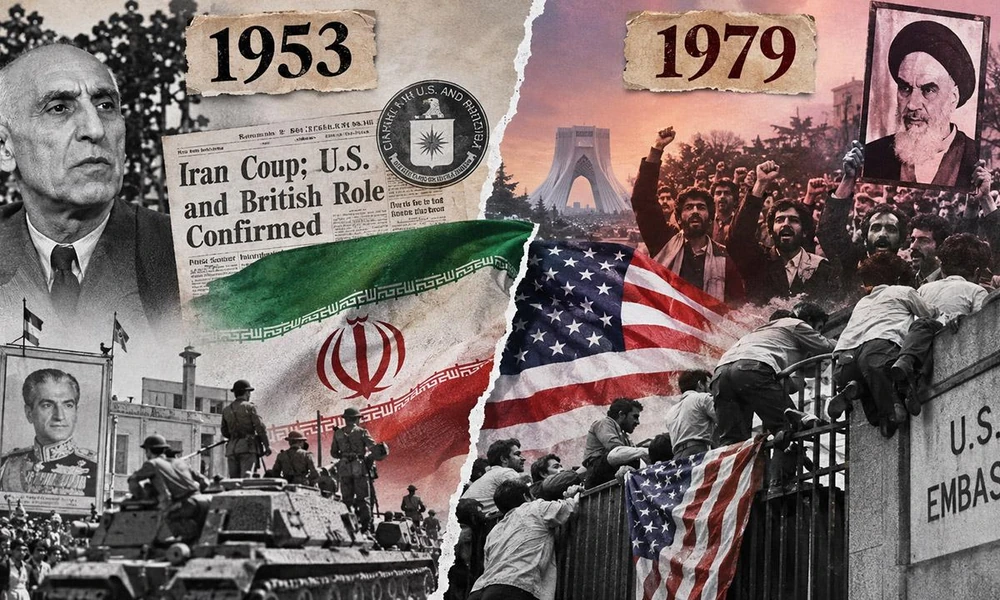
Ask an American when Iran-US relations history turned hostile, and the likely answer is 1979: the fall of the Shah, crowds chanting “Death to America,” and American diplomats held hostage in Tehran for 444 days. Ask an Iranian, and the answer is often 1953, when the CIA and British intelligence helped overthrow an elected prime minister.
Each date tells a story with a clear first offender. In the 1979 version, revolutionary Iran attacked the United States. In the 1953 version, the United States destroyed Iranian democracy, and 1979 was the delayed reaction. Both versions circulate widely and simplify the story.
This piece weighs the evidence for each starting point, using declassified documents, Iranian and American perspectives, and the arguments of historians who think the question itself needs rethinking.
Before the Rift: When Americans Were Iran’s Unlikely Friends
In the early 20th century, the United States was a minor player in Iran compared with Britain and Russia. A few Americans became heroes of Iran’s Constitutional Revolution, which helped build a reputation for the US as a power that did not want to colonize Iran.
The Constitutional Revolution, which began in 1906, created a parliament, the Majlis, to limit the shah’s power. One American, Howard Baskerville, a 24-year-old teacher at the American mission school in Tabriz, was killed in April 1909 while fighting alongside constitutionalists during the siege of that city. Iranians still commemorate him; a bust in Tabriz’s Constitution House honors him.
Two years later, Iran’s parliament hired another American, the lawyer W. Morgan Shuster, as treasurer general to reorganize the country’s finances. Russia, with British acquiescence, forced his dismissal in late 1911, ending that phase of the constitutional experiment. Shuster’s memoir, The Strangling of Persia, made him a lasting symbol in Iran of an outsider who tried to help.
Historians caution against romanticizing this period; some recent scholarship presented at the Middle East Studies Association questions the Shuster myth. Still, the contrast matters. The 1953 coup felt like a betrayal precisely because many Iranians had expected better from Washington.
1953: What the Declassified Documents Actually Show
Mohammad Mosaddegh became prime minister in 1951 and led the nationalization of Iran’s oil industry, which had been controlled by the British-owned Anglo-Iranian Oil Company (later BP). Britain responded with a boycott of Iranian oil and plans to remove him. Under President Truman, Washington tried to mediate. As an LSE historian of international relations wrote in Foreign Policy, after negotiations failed, the new Eisenhower administration, fearing a takeover by Iran’s communist Tudeh Party, authorized the CIA to topple Mosaddegh in 1953.
For decades the US government did not confirm its role. A 1989 State Department documentary volume omitted any reference to CIA involvement. In August 2013, documents obtained by the National Security Archive included the CIA’s own internal history acknowledging that the coup was carried out under CIA direction as an act of US foreign policy. In June 2017, the State Department released a retrospective Foreign Relations of the United States volume with roughly 1,000 pages of records on planning and implementation.
Those records also complicate the heroic spy-thriller version. A first attempt on August 15, 1953, failed, and according to the 2017 documents, CIA headquarters tried to call off the operation before officers on the ground pressed ahead. On August 19, crowds, army units, and royalist officers under General Fazlollah Zahedi took control of Tehran, and they arrested Mosaddegh.
EVIDENCE CHECK: A popular version says the CIA alone toppled Mosaddegh in a slick operation. The documents show a British-initiated plan, an American-led operation that nearly collapsed, and a decisive role for Iranian participants, including the Shah, army officers, paid crowds, and some clerics. Britain, unlike the US, has never officially acknowledged its part.
The historians’ debate
Scholars agree on the foreign role but disagree on its weight. Mark Gasiorowski’s influential 1987 study in the International Journal of Middle East Studies reconstructed the operation and emphasized the centrality of US and British planning. Revisionist historians such as Ray Takeyh of the Council on Foreign Relations argue that Mosaddegh’s coalition was already fracturing and that Iranian actors, including senior clerics who had turned against him, played a significant role. Others reply that the coup could not have succeeded without foreign money, propaganda, and coordination.
The Case for 1953 as the Starting Point
Those who date the rift to 1953 argue that the coup restored Mohammad Reza Shah to fuller power, tied him to Washington, and made the United States the patron of an increasingly authoritarian monarchy. In this view, 1979 was the bill coming due.
After 1953 the US replaced Britain as Iran’s main foreign partner. American advisers helped build the Shah’s security apparatus, including the intelligence agency SAVAK, created in 1957, which became notorious among opponents for its repression. LSE scholar Fawaz Gerges has argued that the coup set a precedent for American intervention in the region more broadly.
A second key moment came in 1964, when Iran’s parliament approved a status-of-forces law giving American military personnel in Iran legal immunity. A then-little-known cleric, Ruhollah Khomeini, denounced it as a return to the humiliating “capitulations” once imposed by European powers and was exiled for it. Khomeini’s later revolution drew directly on that sense of national humiliation.
For many Iranians, 1979 was not the start of hostility toward America but the end of patience with it.
The Case for 1979 as the Real Break
Those who date the rift to 1979 make a different point: for 26 years after the coup, Iran and the United States were close allies. Trade, education exchanges, and military ties flourished, and tens of thousands of Iranians studied in American universities. A grievance over 1953 existed, but it did not stop cooperation between the two governments.
What changed in 1979 was the nature of the Iranian state. The revolution brought to power a system, the Islamic Republic, whose founding ideology cast the United States as the “Great Satan.” On November 4, 1979, students seized the US Embassy in Tehran and held 52 Americans for 444 days. For Americans, that image defined Iran for a generation.
Some participants and observers also question whether 1953 was really on revolutionaries’ minds. Former British foreign secretary David Owen, who served in the Shah’s last years, told NPR in 2023 that linking today’s Iranian government to the coup takes a big stretch of the imagination. And the revolution was itself a coalition. As historian Naghmeh Sohrabi of Brandeis University explored on the Scholars Unravel Middle East podcast, even the question of whether it was an “Islamic” revolution is debated, since leftists, liberals, nationalists, and clerics all took part before Khomeini’s supporters consolidated power.
Beyond Either Date: A Relationship Rebuilt on Grievance
The rift did not stop in 1979. Each side accumulated new grievances: the Iran-Iraq War, the 1988 downing of Iran Air Flight 655, sanctions, the 2015 nuclear deal and the US withdrawal in 2018, and the war that began in February 2026.
During the Iran-Iraq War of 1980 to 1988, the US tilted toward Iraq, even as the Iran-Contra affair revealed secret American arms sales to Iran. In July 1988, the USS Vincennes shot down Iran Air Flight 655, killing 290 people; US officials called it a tragic error, while many Iranians regard it as a crime that was never truly acknowledged. Americans, in turn, point to Iran-backed attacks on US forces, from the 1983 Beirut barracks bombing, which US courts have attributed to Hezbollah with Iranian support, to militia attacks in Iraq.
The 2015 nuclear agreement (the JCPOA) briefly suggested a thaw until the US withdrew in 2018 and reimposed sanctions. Since the US-Israeli strikes on Iran began on February 28, 2026, the two countries have been in open war, with talks mediated by Qatar and others continuing without a breakthrough as of November. Iranian officials and media frequently invoke 1953 to explain mistrust of US intentions; US officials frequently invoke 1979 and the decades of attacks that followed.
Why the Choice of Start Date Is Political
Picking a starting point is never neutral. If the story begins in 1979, Iran is the original aggressor and American policy is a response. If it begins in 1953, the United States is the original offender, and Iranian hostility is a reaction. The Islamic Republic’s official narrative leans on 1953 and earlier British and Russian interference; American political rhetoric leans on 1979.
Some historians argue for going further back, to the Anglo-Russian partition of Iran into spheres of influence in 1907 or to the oil concessions of the early 1900s, which framed foreign involvement in Iran as extraction from the start. Others, such as the writers at Foreign Exchanges, suggest 1953 may actually be overemphasized in popular memory precisely because current Iran-US hostility makes it feel like an origin story.
Why It Still Matters
The 1953-versus-1979 debate is not academic. Diplomats on each side carry a version of this history into negotiations, and each version shapes their expectations of the other side’s likely actions. When Iranian officials doubt American guarantees, they cite 1953; when American officials doubt Iranian ones, they cite 1979.
Reading the news with both timelines in mind does not require deciding who is right. It means recognizing that a single event, such as a broken ceasefire or a tanker seizure, will be read through decades of memory on each side. It also means listening to Iranian sources, from Baskerville’s commemorations to the revolution’s many factions, rather than treating Iran’s history as a backdrop to American decisions.
Frequently Asked Questions
What happened in the 1953 Iran coup? In August 1953, Prime Minister Mohammad Mosaddegh, who had nationalized Iran’s British-controlled oil industry, was overthrown in a coup planned by British intelligence and the CIA and carried out with Iranian army officers, royalists, and paid crowds. Mohammad Reza Shah returned to fuller power afterward.
When did the CIA admit its role in the 1953 coup? In August 2013, the National Security Archive published declassified CIA documents in which the agency acknowledged directing the coup. In 2017, the State Department released a fuller documentary volume on the operation.
Why did the 1979 revolution make Iran anti-American? The revolution replaced a US-allied monarchy with the Islamic Republic, whose leaders portrayed the United States as the main supporter of the Shah and a threat to Iran’s independence. The seizure of the US Embassy and the 444-day hostage crisis turned that hostility into a lasting diplomatic break.
Did the 1953 coup cause the 1979 revolution? Historians disagree. Many see the coup as a long-term source of grievance that shaped opposition to the Shah, while others stress more immediate causes such as repression, inequality, rapid modernization, and the Shah’s 1970s policies.
Were Iran and the US ever allies? Yes. From 1953 until 1979, Iran under the Shah was one of America’s closest partners in the region, with deep military, economic, and educational ties. Earlier, some Americans were celebrated in Iran for supporting its 1906 to 1911 Constitutional Revolution.
Further Listening & Reading
To hear Dr. Naghmeh Sohrabi discuss who made the 1979 revolution and whether it was truly “Islamic,” listen to the Scholars Unravel Middle East podcast or the UME YouTube channel. Explore more through the Unraveling Middle East interview series, the History Behind News program and its sister series, Analyzing American Revolution, or subscribe to the UME email list on the homepage. For today’s frontline of this rivalry, read Strait of Hormuz: 500 Years of Empires Fighting Over One Waterway.

Comments are closed.